Should You Buy the Halo96 Halo75 V2 in 2026? A Deep Dive
When NuPhy first released the Halo series years ago, it redefined what we expected from a pre-built mechanical keyboard. It wasn't just about the typing experience; it was about the "halo" of light, the thick silicone dampening, and that signature rounded aesthetic. Now that we are well into 2026, the market is flooded with hall-effect magnetic switches, rapid trigger technologies, and ultra-budget aluminum boards that would have been unthinkable just a few years back. In this landscape, does the Halo V2—specifically the Halo96 and Halo75 variants—still hold its ground, or is it a relic of a bygone era of keyboard design? I’ve spent the last six months alternating between the Halo96 V2 at my office and the Halo75 V2 at my home setup, and I’ve got some honest thoughts on where these boards stand today.
The Evolution of the V2 Experience
I remember picking up the original Halo75 back in the day. It was heavy, sound-damped to high heaven, and had that striking RGB ring around the base. When I upgraded to the V2 models, the shift wasn't as radical as some might have hoped, but it was refined. After using them through various project cycles, I’ve realized that NuPhy’s focus wasn't on reinventing the wheel, but on perfecting the "thock" and the connectivity. In 2026, where every board seems to be chasing the lowest latency or the most extreme gasket flex, the Halo V2 series feels like a comfortable, reliable pair of denim jeans. It’s not trying to be a specialized gaming tool; it’s trying to be the best daily driver you can put on your desk.
What I found immediately upon unboxing the Halo96 V2 was that the weight hadn't changed much, but the internal profile had. NuPhy moved toward a more sophisticated gasket mount system in the V2 compared to the more rigid structure of the V1. For me, this translated to a softer landing. After testing for several weeks, my fingers felt less fatigued during long coding sessions. It isn't "mushy" by any means, but there is a distinct give when you bottom out that feels premium. I was surprised by how much this changed the acoustic profile as well. The internal silicone (which they call GhostBar and SonicClear filters) has been tuned to remove that high-pitched metallic ping that occasionally haunted the earlier batch of Halo boards I owned.
Design and Aesthetics in the Current Year
Aesthetics are subjective, but in 2026, the "low-poly" or ultra-minimalist trend has taken over most tech. The Halo V2, with its rounded corners and the vibrant "Halo" light strip, feels almost retro-futuristic now. I’ve always appreciated the way the light diffuses through the frosted acrylic band near the base. It doesn't scream "gamer" in the way a Corsair or Razer board might; instead, it provides a sophisticated desk ambiance. I noticed that I often leave the RGB on a slow, warm amber pulse, which makes my desk feel inviting rather than like a command center.
One thing that bothered me, however, was the matte finish on the keycaps. While the double-shot PBT is incredibly durable, after six months of heavy use, I started to notice a slight "shine" on my spacebar and left Shift key. This is standard for PBT over time, but given how much I paid for these, I was hoping the texture would hold up just a bit longer. On the plus side, the mSA profile—which is NuPhy’s own ergonomic height—remains my absolute favorite to type on. It has a slight scoop that hugs the fingertips, making it much harder to "slip" onto the wrong key when I'm typing at 100+ words per minute.
Performance: Typing vs. Gaming
In my experience, if you are a hardcore competitive gamer looking for the 2026 standard of 0.1mm actuation, the Halo V2 might disappoint you. It uses traditional mechanical switches (though the Lemon and Raspberry switches NuPhy offers are fantastic). It doesn't have the magnetic sensors that are currently dominating the Valorant and Counter-Strike scenes. But for 95% of people—myself included—the mechanical feel is still superior for work. I’ve found that many of the modern Hall Effect boards feel "empty" or "linear" in a way that makes typing long articles like this one a chore. The Halo V2 gives me that tactile resistance I crave.
The wireless connectivity is where I saw the biggest improvement over time. Using the 2.4GHz dongle, I haven't experienced a single dropped input in months. Even in 2026, with 6G signals and dozens of wireless devices in my apartment, the connection remains rock solid. I did notice that the battery life on the Halo96 V2 is significantly better than the Halo75 V2, simply due to the larger chassis housing a bigger cell. I can get about three weeks of use out of the 96 with the lights on, whereas the 75 asks for a charge every ten days or so.
Discover deals on Electronics — updated daily.
View Offers →Specific Disappointments
It wouldn't be a deep dive without some gripes. While the "GhostBar"—the silicone-injected spacebar—is a marvel of engineering that makes the spacebar sound as quiet as a regular key, it does make the spacebar feel heavier. I’ve had moments where I felt like the spring wasn't snappy enough to keep up with my thumb. Also, the software. While NuPhy has moved toward QMK/VIA support, which is great for power users, the initial setup is still more cumbersome than it needs to be. I spent a good hour trying to get my custom macros to save to the onboard memory, which is a frustration I thought we would have solved by 2026.
Pros and Cons
- Pro: Solid Build Quality - The combination of an aluminum top frame and a reinforced plastic base gives it a heft that prevents it from sliding around, even during frantic typing.
- Pro: The GhostBar Tech - Finally, a spacebar that doesn't "clack" and wake up everyone in the house. It’s the quietest, most satisfying spacebar I've ever used.
- Pro: Triple-Mode Connectivity - Seamlessly switching between my MacBook (Bluetooth), my gaming PC (2.4GHz), and my iPad (Wired) is handled by a physical toggle that actually feels durable.
- Pro: Aesthetic Lighting - The Halo light strip is genuinely beautiful and provides a unique look that still hasn't been successfully cloned by budget brands.
- Con: Battery Life on smaller models - The Halo75 V2 struggles to stay alive for more than two weeks if you enjoy high-brightness RGB.
- Con: Lack of Magnetic Switches - By 2026 standards, some might feel the lack of "Rapid Trigger" features makes this board overpriced for gaming.
- Con: Keycap Shine - Despite being high-quality PBT, the texture doesn't stay "grainy" for as long as I’d like under heavy use.
Halo96 V2 vs. Halo75 V2: A Comparison
Choosing between the 96% and 75% layouts usually comes down to whether or not you deal with spreadsheets. In my time with both, I found that the Halo96 V2 is the ultimate "everything" board, while the Halo75 V2 is the "clean desk" board. Here is how they stack up side-by-side.
| Feature | Halo75 V2 | Halo96 V2 |
|---|---|---|
| Layout | 75% (83 Keys) | 96% (99 Keys) |
| Weight | Approx. 1100g | Approx. 1500g |
| Battery Capacity | 4000mAh | 5200mAh |
| Best For | Minimalist setups, Gaming | Data entry, Accounting, Productivity |
| Portability | Fits in most backpacks | Desk-bound; quite heavy to carry |
Buying Guide: Is It Right For You in 2026?
With so many options on the market, you need to ask yourself what you actually value in a keyboard. If you are reading this, you are likely looking for something that balances luxury with functionality. Here is how I would break down the decision-making process.
1. The "Thock" Factor
If you are someone who spends hours watching "keyboard ASMR" videos, the Halo V2 is still a top-tier contender. The way NuPhy uses plate silicone and bottom silicone creates a sound profile that is deep and muted. It doesn't have that "hollow" sound that affects many aluminum boards. I’ve compared it to several custom builds that cost twice as much, and honestly, the Halo V2 holds its own. If sound is your priority, this is a "yes."
2. Desk Space vs. Functionality
I found that when I was using the Halo96 V2, I was more productive with my banking and spreadsheet work, but my mouse kept hitting the side of the keyboard during gaming sessions. If you have a smaller desk, the Halo75 V2 is the sweet spot. It keeps the F-row (which I need for shortcuts) but dumps the Numpad to give your mouse arm more room to breathe.
3. The Software Hurdle
Are you comfortable using VIA? If you want a "plug and play" experience where you have a flashy, intuitive app to change every single setting in two clicks, NuPhy’s reliance on open-source firmware might feel like a chore. However, if you want the ability to remap every single key to whatever function you want (including layers for media controls and macros), the QMK/VIA compatibility is actually a massive pro for 2026.
4. The "Future-Proof" Concern
Since we are in 2026, the lack of HE (Hall Effect) switches is the elephant in the room. If you are a high-level gamer, you might feel like you're buying "old" tech. But for everyone else—copywriters, designers, students—mechanical switches are still the gold standard for tactile feedback. The Halo V2 is hot-swappable, so you can always change the switches in 2027 or 2028 if something new and exciting comes out in the 3-pin or 5-pin mechanical space.
Shop the latest Electronics picks on Amazon.
See Deals →My Personal Experience After Six Months
I want to talk about the "settling in" period. Every keyboard feels great for the first week. It’s when you get to month four or five that the cracks show. For the Halo V2, the biggest surprise for me was the stability of the stabilizers. Usually, factory-lubed stabs start to "rattle" after a few months as the grease migrates. NuPhy seems to have used a thicker, more viscous compound in the V2 because my stabilizers are still as silent as the day I bought them. I haven't had to re-lube a single key, which is a first for any pre-built board I've owned.
One thing I noticed that might be a dealbreaker for some: the height of the board. The Halo series is notoriously tall. Even with the integrated feet, it sits high off the desk. In my experience, you almost *need* a wrist rest. I tried using the Halo96 V2 without one for a week and started feeling a strain in my tendons. NuPhy sells matching acrylic or wooden rests, and while they look great, it’s an extra expense you need to factor in. If you prefer low-profile boards (like the NuPhy Air series), the Halo will feel like a literal brick on your desk.
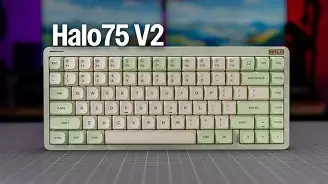
I also spent some time experimenting with the "Halo" light settings. In 2026, I’ve seen some boards with OLED screens or interactive touch strips. The Halo V2 keeps it simple. The light strip actually serves as a battery indicator if you hit a specific key combo, which is incredibly handy. I find that I prefer this subtle utility over a tiny pixelated screen that I never look at anyway. It’s a design choice that has aged gracefully.
Final Thoughts
After months of clicking and clacking away, my conclusion is that the Halo96 and Halo75 V2 are the "sensible luxury" choices of 2026. They aren't the cheapest, nor are they the most technologically advanced in terms of raw gaming performance. What they offer is an unparalleled typing experience out of the box. They feel "finished" in a way that many enthusiast boards don't.
If you want a keyboard that makes you look forward to sitting down at your desk to write, the Halo V2 is still one of the best investments you can make in the electronics category this year. I’ve certainly grown attached to mine. The combination of that muted acoustic profile, the beautiful mSA keycaps, and the reliable wireless performance makes it hard to switch to anything else. Even as newer, flashier boards with holograms or magnetic levitation inevitably hit the market, the simple joy of a perfectly tuned mechanical key-press remains timeless. If you prioritize comfort, sound, and build quality over "gamer" gimmicks, the Halo V2 is an easy recommendation from me, even in 2026.